Bold Brand Development for a Design Educator’s Conference
Roles
- Lead Layout Designer
- Lead UX Writer
- Brand Designer
Tools
- Adobe XD
- Photoshop
- Illustrator
Deliverables
- Complete brand guide layout
- UX Copy documenting design processes for creating assets and layouts in brand style
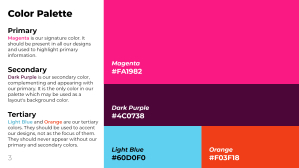
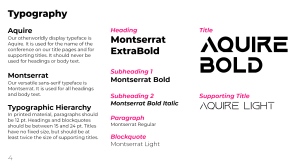
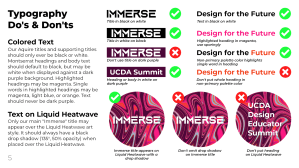
- UX Copy describing proper use of brand typography, color palette
- UX Copy detailing a house writing style for producing future content for the brand
- Asset library in brand’s style for use by future designers
Project Overview
Timeline: 15 weeks
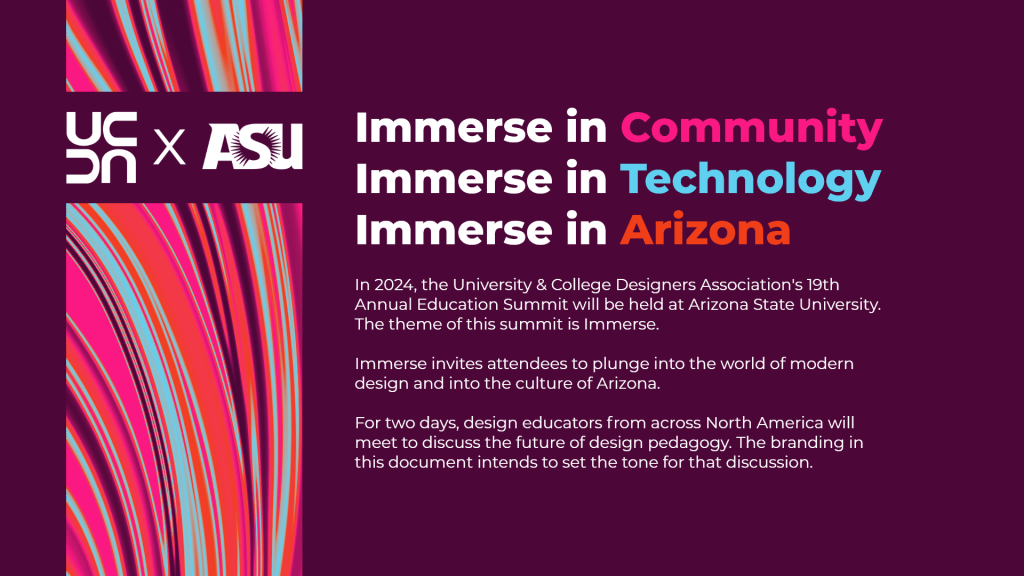
Every year the University & College Designers Association takes its annual conference to a different American university with a different theme. In 2024 the conference would be at ASU with the theme of Immerse.
The GIT Creative Agency was given the job of creating a unique identity for the 2024 conference reflecting the theme of Immerse and Arizonian identity.
Our team was assigned in the early stages of the project. Our goal was to create a brand identity for the conference that could be efficiently applied to various physical collateral by later designers including: conference proceedings booklets, name tags, posters, banners, videos, augmented reality content, and social media advertisements.
I was assigned as the designer responsible for collating all brand identity specifications into a digital style guide, as well as providing write-ups of these specifications explicating them to future designers.
UX Writing Process
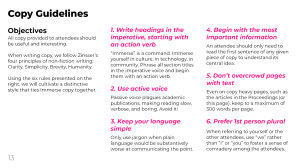
The challenge of writing copy for this style guide was creating instructions which were both precise and concise.
It is my experience that graphic designers, even good ones, often don’t read documentation thoroughly if it is overlong. On the other hand, un-precise instructions are worse than useless when it comes to complicated design directives.
So I strove, throughout the copy in the Immerse Style Guide, to write long, detailed write-ups and then, through careful editing, reshape those write-ups into pithy paragraphs which conveyed their meaning in as few words as necessary and no more.
Challenges & Solutions
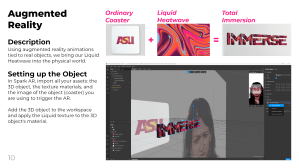
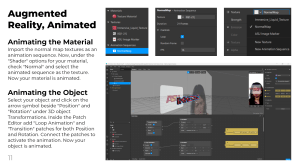
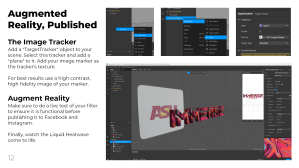
Many of the descriptions I wrote concerned design processes created by other designers. In the case of the Augmented Reality guide, I did not even have a working understanding of the program (Spark AR) being used.
In order to accurately reproduce processes created by other designers, I returned to my roots in journalistic writing.
For processes using programs I was familiar with, I performed detailed interviews of the designers and had them demonstrate their process while I watched. I would use my notes from those interviews to create my copy.
For the Augmented Reality guide, I added an extra step. After my interview, I asked the designer to write a rough draft of the process, taking as much space as she needed. After she was done, I took that rough draft (which was about 3x the length of the guide presented in the finished product and quite jargon-heavy) and edited it for clarity, simplicity, and length. I then gave this draft back to her to check for any technical inaccuracies that I may have introduced in the editing process.
Layout Process
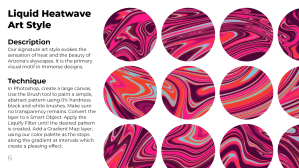
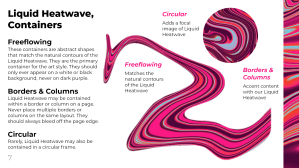
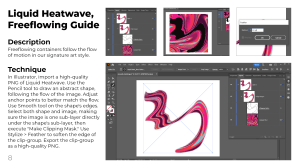
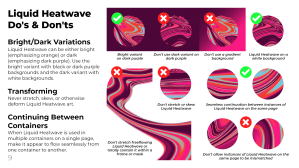
For this layout I wanted to create something clean and modern looking that matched the specifications of brand and style guides of corporations (while on a much smaller scale).
The two examples I drew the most inspiration from were Hulu and T-Mobile’s 2022 brand guides. Both of these guides (and many others I looked at) were designed to be primarily viewed online in 1920x1080p rather than more common print design sizes. This was the size I decided to opt for as well.
From T-Mobile’s guide I took the flexible 3 column design wherein the left column is consistently description, while the right two columns comprise content and are sometimes combined. I also used their idea of having “Do’s and Don’ts” pages to go over common conceptions and misconceptions about their styling.
From Hulu I took their (inspired) decision to organize the size of swatches in their color palette by the percent that this color should show up in a given design.


Challenges & Solutions
The deadline for finishing my style guide was roughly the same as the deadline for many of my fellow designers finalizing the content that I was putting in the guide.
This required a lot of flexibility on my part, including several large last minute changes and additions.
To facilitate the greatest ease for my fellow designers in providing me up to date, accurate information, I made the guide in Adobe XD despite my greater comfort with InDesign. Designing in XD meant that every designer on my team had around the clock access to the latest version of my design and could drop fresh content for me to integrate as soon as they created it.
Examples of final layouts
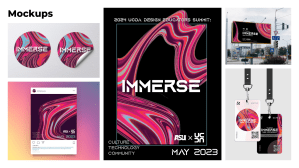
Asset Library
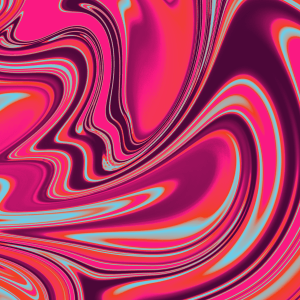
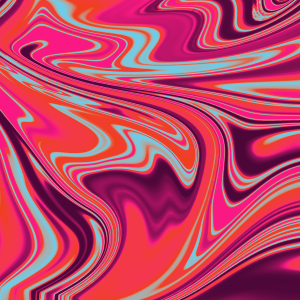
Besides the Style Guide, I was also tasked with creating a library of assets in our signature “Liquid Heatwave” art style that could be readily used by later designers making print and digital collateral.
To do this, I first created two massive Liquid Heatwave master images in Photoshop. I then defined a list of likely use cases for future designers and the likely resolutions, sizes, and color profiles needed for those use cases. I exported a large number of assets using those specifications in readily usable formats.
Starting with the biggest possible versions of the art style and creating smaller assets based on those master files ensured stylistic cohesion between all examples of the style.
Examples

Reflection & Takeaways
I had never worked on a team of designers for a project of this size and complexity before. My main takeaway was how rewarding it could be to collaborate on design work under pressure.
Key to making this teamwork work was accountability and clear definitions of goals and timeline.
GIT Agency used a combination of Trello (for task tracking), Slack (for small team communication), and daily stand-ups (to keep everyone on the same page). All three of those tools along with our shared dedication to the project allowed us to accomplish everything we set out to.
We managed to complete all our deliverables despite every designer on the team having simultaneous assignments with other clients! Good management, organization, and trust really work wonders towards creating great work.
 paul stanton